Ninety Minutes Out: Mapping Didim's Transport Reality Against Listing Addresses

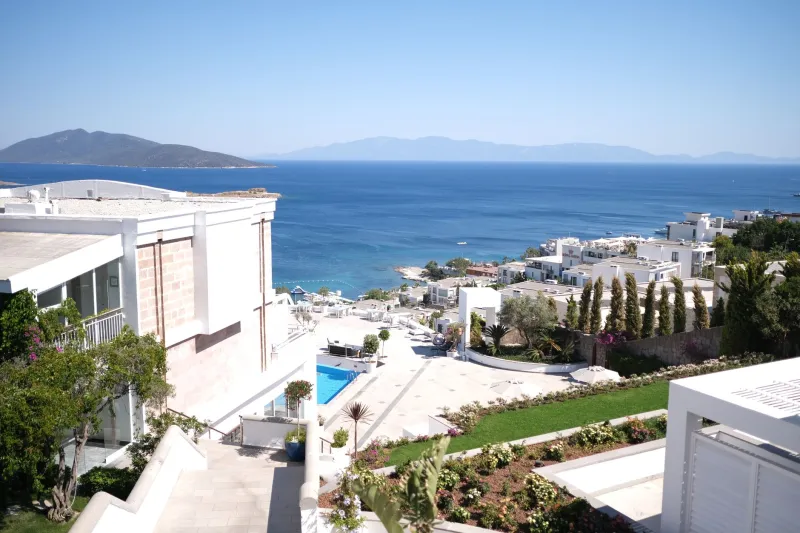
Photo: Wilfredor, CC0, via Wikimedia Commons
On a phone screen, Didim is a small place. The distance between Altınkum and the town center looks like a stroll. The distance to a resort on the eastern edge looks negligible. Then you arrive, the sun is down, the dolmuş has stopped running the route you assumed, and the 'five minutes away' you were promised turns into a negotiation with a taxi driver at an hour when taxis are scarce.
Convenience in Didim is not a function of kilometers. It is a function of corridors, schedules, and the hour on the clock. This is a guide to reading a listing address the way a local reads it.
The three arrival corridors
Almost every international visitor enters the region through one of three doors, and each produces a different budget of time and money.
Milas-Bodrum Airport is the closest commercial gateway and the default for most travelers heading to Didim. Under typical conditions the drive runs well over an hour, and the cost of a private transfer is a fixed, non-trivial line item. Shared shuttle services exist and are cheaper, but they add stops and waiting.
Izmir Adnan Menderes is a larger airport with more flight options, particularly from the United States via European connections. The tradeoff is distance: the road journey is roughly double, and a late arrival can push you into the small hours before you reach the coast.
A smaller number of travelers arrive overland via the regional bus network, which deposits passengers at the central otogar. This is inexpensive and, for anyone staying near the town center, surprisingly efficient.
The practical lesson: pick your accommodation and your bookings after you have picked your arrival corridor, not before. A listing that is perfectly placed for a Milas-Bodrum arrival may be awkward from Izmir.
The dolmuş, and what it will not do
Didim's dolmuş network is the backbone of local movement. It is cheap, frequent on the main arteries during daylight, and genuinely useful for reaching Altınkum, the town center, and the surrounding neighborhoods.
What it will not do is run on your schedule late at night, deviate to a side street, or serve every resort complex directly. Some of the most attractive accommodation sits a fifteen-minute walk from the nearest dolmuş stop — fine in May, punishing in August at midday, and genuinely unwise after midnight.
When you evaluate a listing, the question is not 'is there a dolmuş nearby?' The question is 'what is the last departure on this route, and how do I get back if I miss it?'
Taxis after midnight
Taxi supply in Didim is adequate but not abundant, and it thins considerably in the early hours and in the shoulder seasons. Hailing one on a quiet residential street at two in the morning is not a reliable plan.
Two habits solve most of this. First, ask your accommodation or the provider to arrange a return car in advance — a booked taxi is a different proposition from a hoped-for one. Second, agree the fare or confirm the meter before departure. This is normal practice and nobody will be offended.
Walking distance is seasonal
A kilometer on the seafront promenade in April is a pleasure. The same kilometer in late July, at three in the afternoon, on asphalt, is a different experience entirely. American visitors from temperate states frequently underestimate this.
As a working rule, treat anything beyond a ten-minute walk as transport-dependent rather than walkable for planning purposes, and treat anything beyond twenty minutes as a taxi booking in the summer months regardless of what the map suggests.
Reading an address like a local
Didim's addresses are full of phrases that reward interpretation. 'Near the marina' can mean a two-minute walk or a fifteen-minute one. 'Altınkum' covers a long strip, and the difference between the eastern and western ends is meaningful. Neighborhood names such as Çamlık or Mavişehir describe areas, not precise locations.
Do not accept a neighborhood name as a location. Ask for a pin drop.
The pin-drop test
This is the single most useful habit an American visitor can adopt. Before confirming any arrangement, request the exact location pin in the messaging thread, then open it in your own maps application and check three things: the walking time to your accommodation, the nearest dolmuş stop, and whether the street is a through road or a dead end.
If the provider declines to share a pin, that is not a refusal to be argued with. It is information. Factor it in.
Return logistics, the part nobody plans
The outbound leg is always planned. The return leg is usually assumed. In practice, the return is where budgets blow out and evenings sour.
Before you leave your accommodation, answer three questions in writing: how you are getting there, how you are getting back, and what you will do if the second plan fails. A saved local taxi number and a backup meeting point cover most scenarios.
The ninety-minute rule
Here is a usable heuristic. From the moment you leave your accommodation, count the minutes to arrival, and require the round trip to fit inside a comfortable window relative to the time you have. For an evening booking, a one-way journey over thirty minutes means the return will likely run past midnight, when options narrow sharply.
Listings inside a ninety-minute round-trip radius of where you are staying are, in practical terms, convenient. Listings outside it are viable, but they are excursions, and should be budgeted and scheduled as such.
Geography is the easy part. Timing is what actually decides whether a booking feels effortless or becomes the story of the trip.